
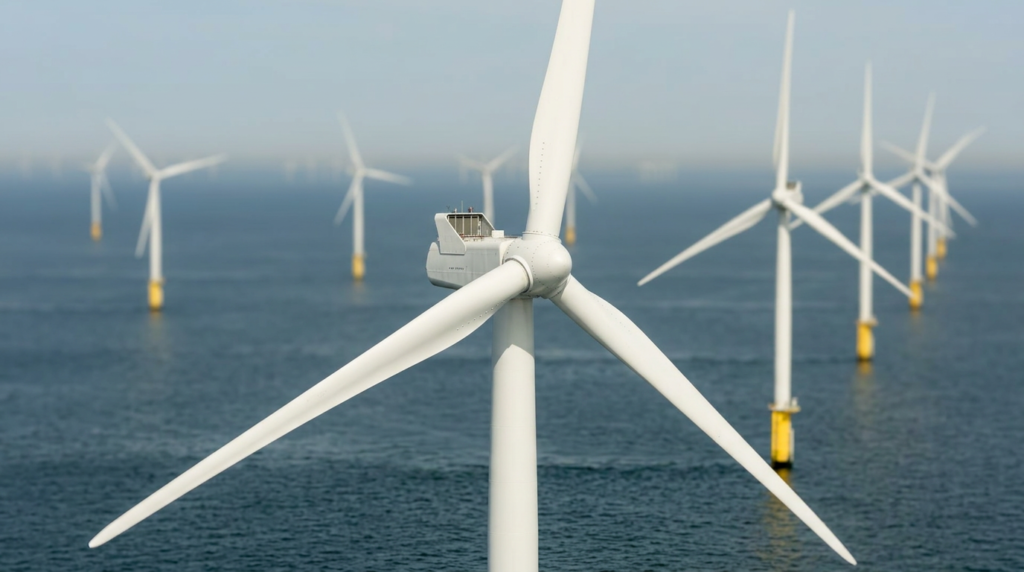
The five biggest offshore wind trends in 2026 are: the rapid scaling of floating wind technology, a growing workforce shortage, accelerating turbine sizes, strong expansion in Asia and the US, and a sharp increase in demand for skilled offshore personnel. These trends are reshaping how projects are planned, staffed, and executed across every major market. Read on for a closer look at each one and what they mean in practice.
What is driving offshore wind growth in 2026?
Offshore wind growth in 2026 is driven by a combination of government policy, falling technology costs, and urgent decarbonisation targets. More countries are committing to large-scale offshore wind capacity as a reliable path to reducing emissions, and that political momentum is translating directly into project pipelines and investment.
Energy security is also playing a bigger role. After years of volatility in fossil fuel markets, governments and utilities are doubling down on domestic renewable energy production. Offshore wind, with its high and consistent output, fits that need well. The result is a global project pipeline that is larger and more geographically diverse than at any point in the industry’s history.
At the same time, supply chain improvements and economies of scale are bringing costs down further, making offshore wind competitive in markets where it previously struggled to gain traction. That combination of policy push and commercial pull is what makes 2026 a genuinely significant year for the sector.
What is floating offshore wind and why is it scaling up?
Floating offshore wind is a technology that mounts turbines on floating platforms anchored to the seabed rather than fixed foundations. This allows wind farms to be installed in deeper waters, far from shore, where wind resources are stronger and more consistent. In 2026, floating wind is moving from pilot projects to commercial-scale development.
The reason it is scaling up now comes down to geography. The best shallow-water sites in Europe are largely taken. Countries like Japan, South Korea, Norway, and the US West Coast have deep coastlines that make fixed-bottom wind impractical. Floating technology unlocks those markets entirely.
Several large floating wind projects are currently in development or early construction across Europe and Asia. The technology is still more expensive than fixed-bottom wind, but costs are falling as more projects are built and supply chains mature. Most industry forecasts expect floating wind to become a mainstream part of the offshore energy mix within this decade.
How is the offshore wind workforce shortage affecting projects in 2026?
The offshore wind workforce shortage is causing real delays and cost pressure on projects in 2026. There are simply not enough qualified offshore technicians, engineers, and crew to meet the pace of global expansion. This is one of the most immediate operational challenges facing project developers right now.
The shortage is structural, not temporary. The industry grew quickly, and training pipelines did not keep pace. Experienced professionals from oil and gas are being recruited into renewables, but that crossover takes time, and not everyone makes the transition. Meanwhile, new talent entering the sector needs years of supervised experience before they can work independently on offshore installations.
For project managers, this means that finding qualified offshore professionals is now a competitive activity. The projects that start on time are often the ones that locked in their crew and technical staff well in advance, rather than waiting until the project was confirmed.
Which countries are leading offshore wind expansion right now?
The countries leading offshore wind expansion in 2026 are the United Kingdom, Germany, the Netherlands, China, the United States, and Taiwan. Each is investing heavily in new capacity, though their approaches and timelines differ significantly.
China remains the world’s largest offshore wind market by installed capacity and continues to build at a pace that outstrips all other nations. In Europe, the UK, Germany, and the Netherlands are pushing through large-scale projects in the North Sea, supported by long-term government contracts. The US is in an earlier stage but is accelerating fast, particularly off the East Coast.
Taiwan is the standout story in Asia outside China, having built a strong regulatory framework that has attracted major international developers. South Korea and Japan are investing heavily in floating wind as a way to tap their deep-water coastlines.
For staffing and recruitment, this geographic spread matters. Projects are running simultaneously across multiple continents, which puts pressure on the same global talent pool. Understanding the industries we serve and where activity is concentrated helps companies plan their workforce strategies more effectively.
How are larger turbines changing offshore wind project planning?
Larger turbines are changing offshore wind project planning by reducing the number of units needed per project, which lowers installation costs but increases the complexity and specialisation required for each individual turbine. In 2026, turbines in the 15 to 20 MW range are becoming the new standard for large-scale projects.
Bigger turbines mean bigger components, heavier lift requirements, and more specialised installation vessels. They also require technicians with experience on specific platforms and systems that are still relatively new. This creates a skills gap within the workforce even among experienced professionals, because someone with ten years of experience on older turbines may need retraining before they can work on the latest generation.
Project timelines are also affected. Installation windows are shorter and more weather-dependent when working with larger structures. That makes precise crew planning and rapid mobilisation more important than ever. A delay in getting the right people to the right location at the right time can have a significant knock-on effect across an entire project schedule.
What does the offshore wind boom mean for staffing and recruitment?
The offshore wind boom means that demand for skilled offshore personnel is outpacing supply in almost every major market. Staffing and recruitment have become strategic priorities for project developers, not just administrative tasks. Companies that treat workforce planning as an afterthought are finding it increasingly difficult to start projects on schedule.
The roles in highest demand include installation and commissioning engineers, offshore supervisors, HSE officers, marine coordinators, and turbine technicians. Many of these professionals have transferable skills from oil and gas or maritime, but the crossover is not automatic and requires careful screening.
International mobility is also a growing factor. Projects in Taiwan, the Gulf of Mexico, or the Norwegian Sea all require professionals who can work across borders, often under complex visa and employment arrangements. That means payroll compliance, contract structure, and international HR logistics are just as important as finding the right candidate in the first place.
How iPS Powerful People helps with offshore wind staffing
We have been placing technical professionals in the energy and maritime sectors for over 35 years, and offshore wind is one of our fastest-growing areas of activity. Whether you need a single offshore supervisor or a full project crew, we can help you build and manage the team you need.
- Crewing and secondment for offshore wind installations, from survey vessels to installation and commissioning teams
- Full project staffing across the entire project lifecycle, so you have one partner from mobilisation to handover
- International payroll and compliance, with candidates on our own payroll and full coverage of A1 certificates, local employment law, and cross-border contracts
- Candidate screening on QHSE standards, because every placement in a safety-critical environment meets international safety requirements before anyone steps offshore
- Local market knowledge through our offices in the Baltics, Croatia, the Netherlands, Dubai, Mexico, and the US, which means we understand local labour markets and regulations wherever your project is located
- B Corp certified, reflecting our commitment to social and environmental standards that align with the values of the renewable energy sector
Want to know more about how we work or ready to discuss your next project? learn about our approach or get in touch with our team directly. We are happy to talk through what you need and how we can help you get your project staffed and started on time.